


TLDR
RevOps (Revenue Operations) applies the DevOps (Development and Operations) model to revenue. Twenty years ago, software teams split into “dev” (ship fast) and “ops” (keep stable), until Patrick Debois named the conflict at a conference in Ghent in 2009. The DevOps movement that followed produced the operating model most modern software companies now run on. RevOps borrows the move for marketing, sales, and service. The funnel is the casualty: Brian Halligan retired it at HubSpot’s INBOUND 2018 in favour of the flywheel, rooted in Jim Collins’s Good to Great (2001). For digital marketers in 2026, the question becomes “how fast does our flywheel spin, and where is the friction?” This article maps the answer using maths, references, and moves that pay off within the quarter. Join the conversation on Thursday, 14 May 2026, 17:00–17:30 CEST (Central European Summer Time) — 30 minutes, 2 practitioners, no slides.
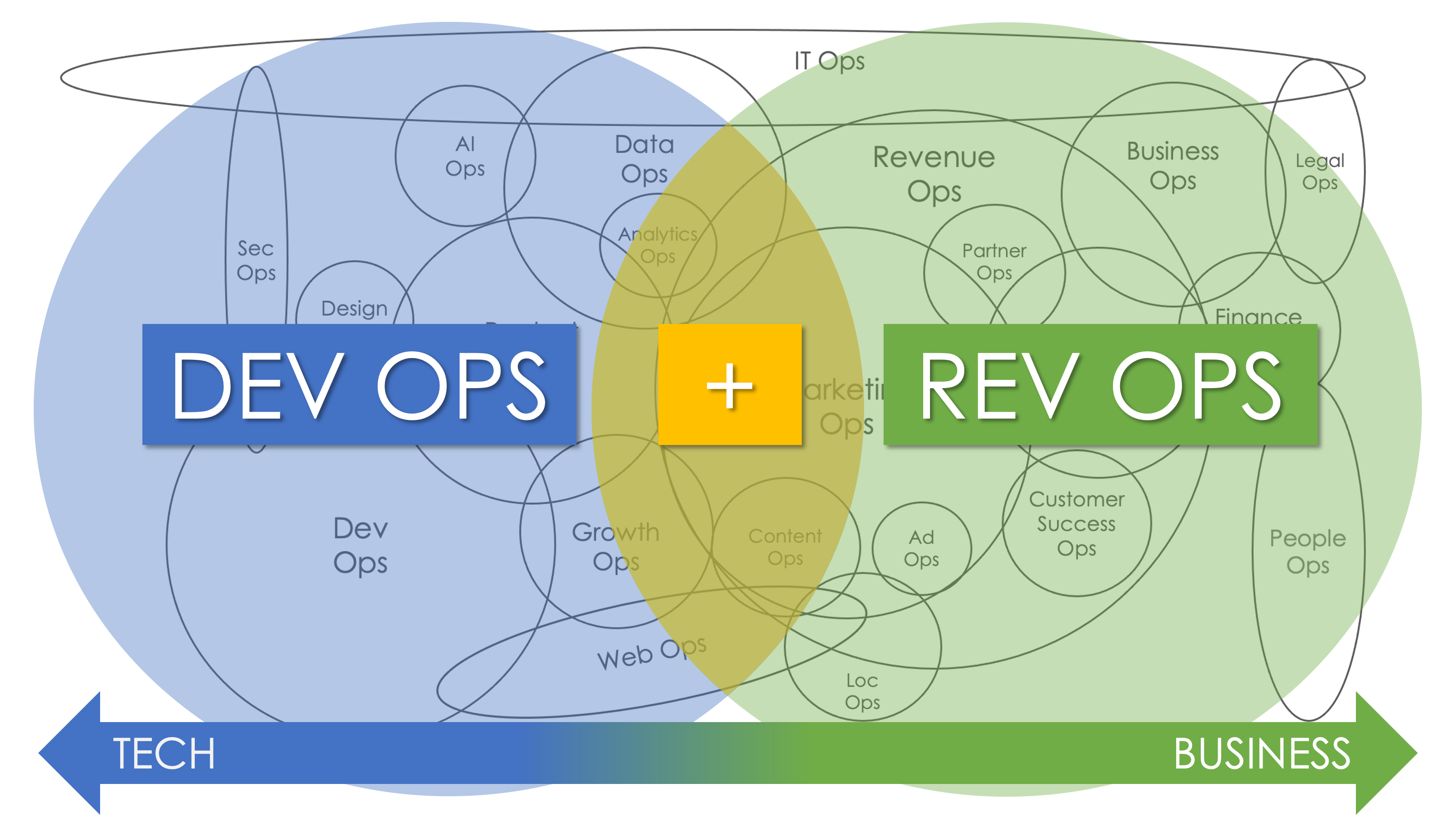
RevOps inherits from DevOps
In 2008, Patrick Debois — a Belgian systems administrator on a government project — was frustrated. Developers were paid to ship features fast. Operations were paid to keep systems stable. Every release, the two fought, and customers paid the price. He named the problem “DevOps” at a conference in Ghent in 2009. The fix had three pillars: shared metrics (deployment frequency, lead time for changes, MTTR or mean time to recovery, change failure rate — formalised by Nicole Forsgren and colleagues across the DORA, DevOps Research and Assessment, State of DevOps reports 2014–2024 and the book Accelerate); shared ownership (“you build it, you run it”); shared cadence (blameless postmortems, daily stand-ups, weekly demos). The 2024 DORA report shows elite engineering teams deploying 200x more frequently than low performers and recovering from failures 24x faster.
RevOps borrows the same shape. Marketing builds a pipeline (ship fast). Sales close it (keep stable). Service retains and expands the customer (uptime). Same conflict, same fix.
Why the funnel had to go — and what replaces it
The funnel was the 1898 model — E. St. Elmo Lewis’s AIDA: Attention, Interest, Desire, Action. By 2018, it had stopped describing how buyers actually behaved. Brian Halligan, then HubSpot’s CEO (Chief Executive Officer), retired it at INBOUND 2018 in favour of the flywheel — an idea Jim Collins articulated for business in Good to Great and Jeff Bezos sketched on a napkin for Amazon the same year.
The argument is arithmetic. In funnel thinking, every customer who exits at the bottom is a terminal event. In flywheel thinking, customers stay at the centre, and their satisfaction creates the next round of growth through referrals, expansion, peer recommendations, and content. Three forces accelerate the wheel: attract, engage, delight. Friction at the handoffs slows it.
The financial weight: Fred Reichheld at Bain (The Loyalty Effect, 1996; reconfirmed 2003) estimated a 5% lift in retention with a 25–95% profit lift. HubSpot State of Service 2024 reports 93% of consumers are more likely to repurchase after great service. The BVP (Bessemer Venture Partners) Cloud Index shows the median public SaaS (Software-as-a-Service) company at 120% NRR (Net Revenue Retention) trading at 2.5x the EV/Revenue (Enterprise Value to Revenue) multiple of one at 90% NRR.
The maths in one example. A B2B (business-to-business) company at €10M ARR (Annual Recurring Revenue): at 90% NRR, you need €1M of new business every year just to stand still; at 120% NRR, you grow €2M without selling a single new logo. Same marketing budget, eight times the net growth. The flywheel is the arithmetic of compounding revenue.

Where digital impacts the top line
Four levers, in order of leverage. Each is backed by published research.
1. Cycle time — idea to revenue. Forrester’s 2024 RevOps benchmark: top-quartile B2B teams compressed MQL-to-closed-won cycle time by 38% over three years. Halving cycle time while keeping pipeline constant doubles ARR velocity. Moves: live chat on high-intent pages (Drift 2024 — 67% pipeline lift); calendar booking embedded in the response email (Chilli Piper — 25–40% self-book); pre-meeting qualification questionnaires (≈22 minutes saved per opportunity).
2. Response speed — the 5-minute rule. Harvard Business Review / InsideSales.com Lead Response Management Study (2011): a lead contacted within 5 minutes is 21x more likely to qualify than one contacted at 30 minutes; contact rates drop 10x after the first hour. Across four Swiss SMEs (small and medium-sized enterprises) audited in 2025, the median response time was 14 hours, and the P90 (90th percentile) was 47 hours — roughly 80% of the spend that produced those leads was wasted at the handoff. This is the DevOps MTTR of revenue. The fix: a 5-minute response SLA (Service Level Agreement) during working hours, tracked in your CRM (Customer Relationship Management system), alerted via Slack, escalated at 15 minutes. Typical month-one lift: 30–50% lead-to-meeting. Cost: zero new tools.
3. Retention as growth. BVP Cloud Index rule of thumb: every dollar in retention returns 5–7x the dollar in net-new acquisition over three years. Stand up an NRR dashboard with the same prominence as the pipeline dashboard. Move 20% of paid acquisition budget into customer expansion content. Treat NPS (Net Promoter Score) as a lagging indicator; activation rate, time-to-value, and depth-of-usage are leading.
4. The dark funnel. Chris Walker’s research at Refine Labs (now Passetto): 60–80% of B2B buyer interactions occur in channels that generate no clicks — podcasts, Slack communities, LinkedIn comments, peer conversations. The fix: add an open-text field to every form — “How did you first hear about us?” — and treat the answer as ground truth. Companies that do this typically find 30–50% of their pipeline credits in a channel that last-click attribution showed as zero.
Why buyers decide before sales get the call
The B2B buying journey has flipped. Forrester’s 2024 study: an enterprise purchase involves 11–20 people across 16–17 interactions, most of which happen through peers, online research, and content rather than the sales team. Gartner has shown for years that B2B buyers are 57–70% of the way to a decision before they speak to a salesperson.
Translated: by the time your SDR (Sales Development Representative) books a meeting, the decision has already been shaped by the content the buyer read, the peers they consulted, and the reviews they trust. Dashboards reading “150 MQLs (Marketing-Qualified Leads), 18 SQLs (Sales-Qualified Leads), 12% conversion” tell a 2015 story in a 2026 market: two-thirds of those SQLs had picked a vendor before the meeting was booked, and most of the spend on the other 132 MQLs went into the gap between marketing automation and sales follow-up.
US, Europe, and the Swiss sharp end
The flywheel is universal. The mass-and-friction profile varies.
The US plays volume. Typical mid-market US SaaS company: 15–40-person SDR floors, 80–120 personalised emails per rep per day plus 50+ cold calls, paid acquisition at 25–40% of revenue, 1–3% reply rates accepted as cost of doing business. First-year churn 15–20% (Bessemer), CAC (Customer Acquisition Cost) payback averaging 28 months in 2024.
Europe plays trust. Typical European mid-market team: 3–8 reps, paid acquisition under 10% of revenue, cold-outreach reply rates under 0.5% because GDPR (General Data Protection Regulation) makes US-style cadences illegal (consent, retention, opt-out) or commercially toxic. Retention is structurally higher: European mid-market churn 7–10% (Forrester), CAC payback under 18 months.
Switzerland is the sharp end. Commercial teams of 5–12 people. Customer relationships are measured in decades. FADP (Federal Act on Data Protection) plus GDPR-equivalent, plus FINMA (Swiss Financial Market Supervisory Authority) for financial services. The addressable market is small, ad inventory dries up by Q2 (the second quarter of the year), and cost-per-qualified-meeting in DACH (Germany, Austria, Switzerland) for industrial-services keywords now exceeds CHF 400 (Swiss Francs). Swiss B2B mid-market churn sits at 4–6% (SECO — State Secretariat for Economic Affairs).
Strategic implication: imported US playbooks in Europe spend US-style money to produce European-style replies. European top-line growth comes from spinning the flywheel harder at retention and expansion.
Three open questions
Worth asking your marketing, sales, and service teams on Monday. The webinar will press the same three.
Q1 — What broke in your funnel, and how would you spot it on a Monday morning?
The 2025 audit pattern across four Swiss mid-market clients: MQLs up 2–3x year-on-year, pipeline flat. The leak lived between marketing-automation handoff and the first human call (numbers in the response-speed section above). Three tests for your own funnel this week:
- Response-time distribution for the last 200 inbound leads. Median over four hours = same leak. P90 over 24 hours = structural.
- Twenty won deals from last quarter. Pull first touch and first human reply. If most wins came through inbound with sub-one-hour follow-up, that is where your real funnel lives.
- Lead-to-meeting conversion by source. The highest-spend source with the lowest conversion-to-meeting means the leak is speed — creative comes after that.
Pull the response-time distribution before Thursday. Twenty minutes of work. Bring the number. We will compare notes live.
Q2 — Everyone speaks now about RevOps. How do you tell the real thing from a rebadged retainer?
Forrester’s 2024 benchmark: companies with a formal RevOps function grow ~19% faster and are ~15% more profitable. The label has been bolted onto numerous agency decks over the last twelve months.
A real RevOps engagement starts with a 2-week diagnostic mapping every handoff between marketing, sales, and service — measured cycle times and conversion at each gate — and produces a written re-design before any platform configuration. A rebadged retainer starts with “we’ll build you a new HubSpot/Salesforce workflow,” takes six weeks to configure, and reports activities (emails sent, calls logged) rather than outcomes.
Three sub-questions for any partner before signing:
- What will you measure first, and how, in week one?
- When the marketing-to-sales handoff breaks, who owns the fix — and what is the SLA?
- Show me three engagements where you did not recommend new software.
If you are currently evaluating a RevOps partner, bring their pitch deck. We will read it together and call out the tells as we go.
Q3 — One quarter, no software budget. Which three moves pay back fastest?
The honest answer from the 2025 audit set.
Three moves that pay back inside 90 days:
- A 5-minute response SLA on high-intent leads. Tracked in your CRM, alerted via Slack, escalated at 15 minutes. Typical month-one impact: 30–50% lift in lead-to-meeting.
- A weekly 30-minute revenue stand-up. Marketing, sales, service, and one ops person. One slide of last week’s gate conversions. The second meeting surfaces the leak; the fourth produces the fix.
- A shared written “sales-ready” definition. Marketing and sales write it separately, then compare. Typical impact: 15–25% fewer leads passed, 2–3x lift in lead-to-opportunity conversion.
Two moves to make room: drop quarterly persona refreshes that change nothing in the handoff; pause new marketing-platform evaluations as the first response to a pipeline problem. Fix the handoff first, then evaluate the tool.
Write down the three moves you would commit to and the two you would cut. Bring the list. We will stress-test it live.
When RevOps isn’t the answer
RevOps fits a defined set of businesses. Three situations sit outside that set.
The very small company. Five people, one room — the handoff is a walk across the office. A recent audit: a four-person SaaS company had a twelve-stage Salesforce pipeline; removing eight stages doubled the close rate within a month.
A deeply technical product. If buyers spend most of their time in trials, documentation, or developer forums, the decision lives there. One developer tools company spent six months optimising the MQL-to-SQL handoff; the fix, which lived in the free trial signup, increased activated users from two-step to one-step by 38%.
True self-serve. If customers sign up, pay, and use your product without speaking to a human, the winning model is product-led: activation, time-to-value, and expansion as the three core metrics.
The closing question for the webinar: which applies to your business today? Which used to apply but has changed? And where would you draw the line differently from the two people on the call? Even if one applies, come anyway — the most useful conversation is likely the one where we agree your business should adopt something other than RevOps.
30 minutes, 2 practitioners, no slides. Thursday 14 May 2026, 17:00–17:30 CEST. Bring questions.
References
- Patrick Debois, Agile Infrastructure & Operations, Ghent, 2009 — origin of the DevOps movement.
- Nicole Forsgren, Jez Humble, Gene Kim, Accelerate: The Science of Lean Software and DevOps, 2018; DORA State of DevOps reports, 2014–2024.
- Brian Halligan, The Flywheel Replaces the Funnel, INBOUND 2018.
- Jim Collins, Good to Great, 2001.
- Fred Reichheld, The Loyalty Effect, Bain & Company, 1996.
- HubSpot, State of Service 2024.
- Harvard Business Review / InsideSales.com, Lead Response Management Study, 2011.
- Chris Walker / Refine Labs / Passetto — dark funnel research.
- Forrester, B2B Buying Study 2024; Revenue Operations Benchmark 2024.
- Gartner, The B2B Buying Journey.
- McKinsey, Lead Response Time and B2B Conversion; Digital B2B Growth, 2024.
- Bessemer Venture Partners, Cloud Index.
- SECO, Swiss SME Commercial Benchmarks, 2024.
- Pupsic internal audit data, Swiss SME engagements, 2025.